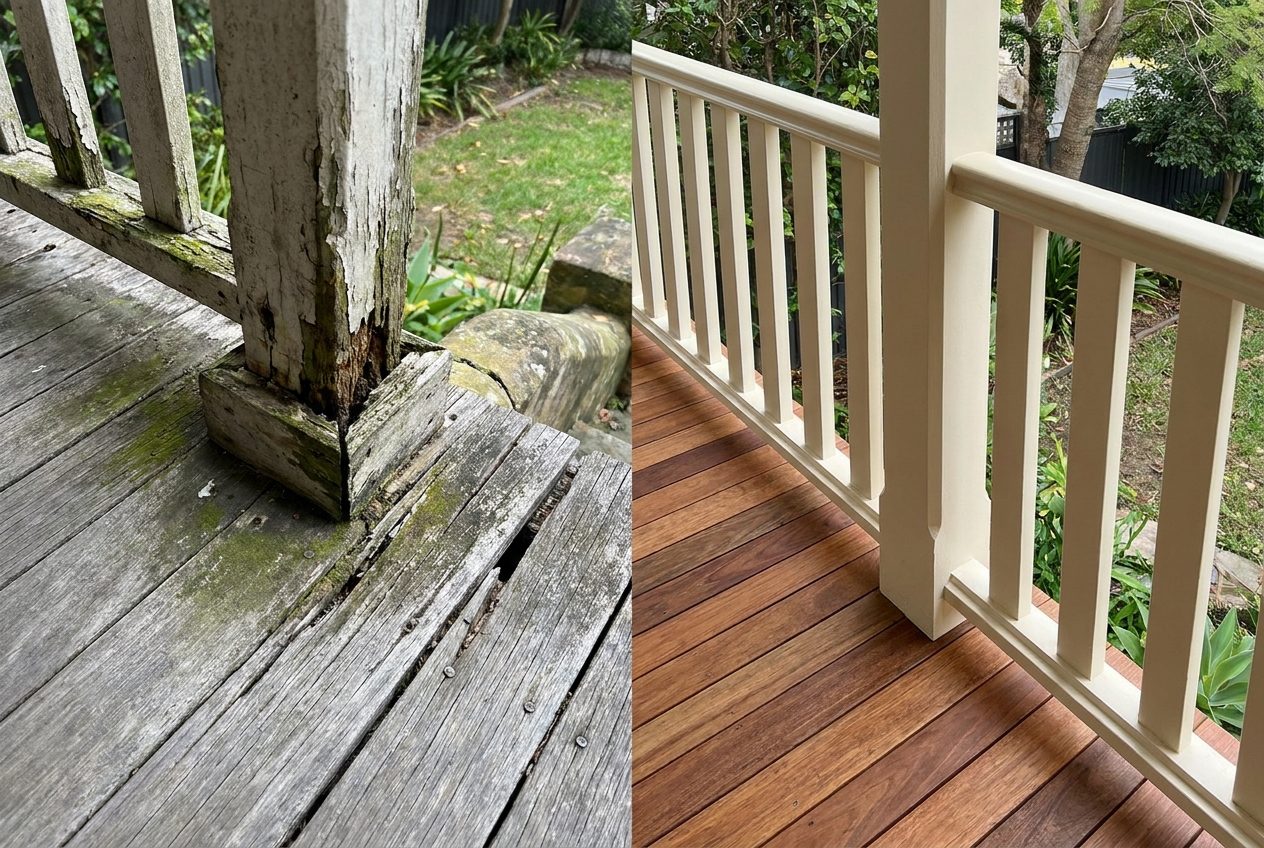
Should you repair or replace a timber verandah? It is one of the most common questions owners of older Sydney homes ask, and the honest answer is that it depends on which parts have failed, why they failed, and how much of the original is worth keeping. Many verandahs that look tired only need targeted repairs. Some that look fine from the street are failing underneath.
This guide gives you a practical way to decide whether to repair or replace a timber verandah: part-by-part tests, a decision table, cost considerations, heritage rules, and the questions to ask before you commit.
Repair or Replace a Timber Verandah: The Quick Answer
Repair a timber verandah when the damage is limited to individual boards, post bases, fixings or decorative pieces and the subframe and roof are sound. Replace it when the subframe has failed across much of the floor, several posts have rotted through, the roof structure has sagged or was never properly built, or the verandah does not meet safety requirements and cannot reasonably be brought up to them. On heritage homes, keeping original fabric is usually preferred, and sometimes required.
- Repair: limited rot, a few boards, post bases, loose detail, sound subframe
- Partial replacement: floor and subframe, or posts and beams, while keeping the roof and detail
- Replace: widespread structural failure, unsafe or non-compliant structure, or a poor earlier rebuild
- Always fix the cause of the decay, or new timber will fail too
Why Timber Verandahs Fail
Before you decide to repair or replace a timber verandah, it helps to understand why it failed. Almost every failure comes back to water:
- Poor falls: floors that do not slope away from the house hold water.
- Failed flashing: water gets behind the wall junction and rots the joists and bearers there.
- Blocked gutters: overflow pours onto beams, posts and boards.
- Posts in contact with water: post bases set into concrete or sitting in puddles rot from below.
- No ventilation underneath: damp subfloors rot framing from below.
- Termites: especially where the verandah meets the house.
- Age: some verandahs simply reach the end of their life.
If you repair without addressing the cause, you will be repairing again in a few years.
What a Good Verandah Inspection Should Tell You
You cannot decide whether to repair or replace a timber verandah without knowing what is under the surface. A useful inspection covers:
- Floor: soft or cupped boards, fall away from the house, gaps and fixings
- Subframe: condition of joists and bearers, especially at the house wall and over piers, checked by lifting boards where needed
- Piers and footings: movement, cracking or sinking
- Posts: base condition, splits, termite damage and how they are fixed
- Beams and roof framing: sag, rot at joints, rafter condition
- Roof: sheeting condition, rust, leaks and gutter condition
- Flashing: at the house wall, and any signs of water getting in
- Detail and balustrade: what is original, what is missing, what is loose
- Termites: mud tubes or hollow timber, with a referral to a pest controller if needed
- Photos: so you can see what the carpenter saw
With that information, each part can be marked repair, partly replace or replace, and the decision becomes clear.
Choosing Timber So Repairs Last
Whether you repair or replace, the timber choice decides how long the work lasts. Verandah floors and posts are fully exposed to weather, so durable hardwoods or appropriately treated timber are used, with all cut ends sealed. Framing that sits close to the ground needs the right durability or treatment level for in-ground or above-ground exposure. Fixings should be galvanised or stainless, especially in coastal suburbs. Using the right material in each position costs a little more but avoids repeating the job.
Repair or Replace: A Part-by-Part Guide
Floorboards
Repair if only some boards are soft, split or cupped, especially at the edge or ends. Replace those boards and check the joists under them.
Replace the floor if most boards are cupped, split, soft or loose, or if the floor has no fall and holds water.
Joists and bearers
Repair if decay is limited to the ends of a few members. They can be sistered or partly replaced.
Replace if rot or termite damage runs along members, the floor has dropped, or the subframe was undersized from the start. Our guide to signs of damaged bearers and joists helps you spot this.
Posts
Repair when rot is limited to the base. A new section can be scarfed in and the post set on a proper stirrup.
Replace when rot runs up the post, the post is split, or termites have hollowed it. Turned posts can be made to match.
Beams and plates
Repair minor damage at joints.
Replace if a beam has sagged noticeably, split or rotted, which usually means the roof needs propping while it is done.
Roof framing and sheeting
Repair individual rafters, battens or sheets.
Replace when the roof has sagged across its length, the framing was poorly built, or a bullnose has lost its shape and sheeting is rusted through.
Decorative detail
Repair and refix whenever possible. Missing fretwork, brackets or lace can be copied from surviving pieces.
Replace only pieces that are rotted through, using matched profiles.
Balustrade
Repair loose balusters and rails if the balustrade is sound and adequately secure.
Replace if it is unsafe, cannot be made secure, or the gaps are large enough for a child to get through. If you are replacing it, it should meet current requirements.
Decision Table: Repair or Replace a Timber Verandah
| What you find | Usually repair | Usually replace |
|---|---|---|
| A few soft boards at the edge | ✔ | |
| Most boards cupped or soft | ✔ (floor) | |
| Joist ends rotted against the house | ✔ (sister or splice) | |
| Floor has dropped across its width | ✔ (subframe) | |
| Post base rotted, upper post sound | ✔ (scarf repair) | |
| Post rotted or hollowed along its length | ✔ (post) | |
| Beam sagging or split | ✔ (beam) | |
| Loose or missing fretwork | ✔ (refix and copy) | |
| Roof sagging across its length | ✔ (roof framing) | |
| Earlier poor-quality rebuild throughout | ✔ (rebuild) |
Most real jobs are a mix: repair the parts that are sound, replace the parts that are not. That is usually the best value way to repair or replace a timber verandah.
Repair or Replace a Timber Verandah: Cost Considerations
Repairs are almost always cheaper than replacement when most of the structure is sound. A 2026 cost guide (SA pricing) puts light verandah restoration at about $8,000 to $20,000, substantial restoration at about $15,000 to $35,000 and comprehensive restoration at about $30,000 to $55,000, with new heritage replica verandahs in a similar or higher range. See our verandah restoration cost Sydney guide for the full published ranges and what drives them.
Three cost points are worth keeping in mind:
- Hidden damage: repairs can grow once boards come up. A good inspection reduces this risk.
- Detail matching: bespoke turned posts and fretwork cost more than plain replacements but suit the house.
- Repeat repairs: patching a verandah that is failing everywhere can cost more over time than doing it properly once.
Heritage Homes: Why Repair Is Usually Preferred
On federation, Victorian and inter-war homes, the verandah is often the most important part of the street facade. Heritage practice generally favours repairing original fabric and replacing only what has failed, using matching materials and profiles. If your property is in a heritage conservation area or individually listed, your council may require this approach and consent may be needed for visible changes. Like-for-like repairs are often treated differently from alterations, so check with your council.
Our guide to heritage balcony restoration in Sydney and our Rozelle heritage balcony rebuild show this approach in practice.
Safety and Compliance
If the verandah floor is high enough off the ground, a balustrade is required, and replacement balustrades should meet the current National Construction Code. Repairs to an existing verandah do not always trigger a requirement to upgrade everything, but a restoration is a good time to make the verandah safer, especially for children. The NCC Housing Provisions set out stair and barrier requirements for homes.
Repair or Replace a Timber Verandah in Sydney: Local Patterns
Inner West terraces
Two-storey verandahs and balconies with cast iron lace. Usually repaired and restored in place, often within heritage controls. See carpenter Rozelle.
St George federation homes
Bullnose roofs, turned posts and timber fretwork. Typically a mix of repair and partial replacement. See carpenter St George.
Waterfront and coastal homes
Salt air speeds up corrosion of fixings and decay. Expect more replacement of fixings and boards.
Post-war homes with added verandahs
Verandahs added later are sometimes poorly built. Replacement is more common, and a new verandah can be designed to suit the house.
How to Decide: A Step-by-Step Process
- Look and note: soft boards, sloping floor, rotted posts, sagging roof, loose detail.
- Get an inspection: a carpenter lifts boards where needed and probes timber.
- Find the cause: falls, flashing, gutters, ventilation, termites.
- List each part: repair, partial replacement or replacement.
- Check heritage and approvals.
- Compare quotes based on the same scope.
- Plan maintenance so it lasts.
How Verandah Repairs Are Actually Done
Knowing what a repair involves makes it easier to judge whether to repair or replace a timber verandah. These are the most common methods.
Board replacement
Damaged boards are cut out between joists and new boards of matching width and profile are fitted. Where the original species is no longer available, a durable hardwood with a similar look is used. The joists under the removed boards are checked while they are exposed.
Sistering joists
A new joist is fixed alongside a weakened one and bolted or nailed through, so the new member carries the load. This keeps the original in place and avoids lifting the whole floor.
Splicing a rotted joist end
Where only the end of a joist has rotted at its bearing point, the rotted section is cut out and a new section joined in with a properly designed lap or bolted connection, supported on a new or packed bearing.
Scarfing a post base
The rotted base of a post is cut away and a new section of timber of the same profile is joined in with a long angled scarf joint, glued and fixed. The post is then set on a galvanised stirrup that keeps the end grain off the floor.
Refixing and copying decorative detail
Loose fretwork and brackets are removed, repaired, primed on all faces and refixed with non-corroding fixings. Missing pieces are traced from surviving ones and copied. Cast iron lace is refixed, and broken panels are sourced or recast where possible.
Flashing and drainage fixes
The junction between the verandah roof or floor and the house wall is reflashed, gutters are checked and downpipes are directed away from the house. These are small jobs that decide whether the repairs last.
If You Replace: Like-for-Like or Redesign?
If replacement is the right answer, you still have choices.
- Like-for-like: rebuild to the original design, profiles and materials. Usually expected on heritage homes and the best choice for period character.
- Sympathetic redesign: keep the proportions and style but simplify some details. Can save cost on homes outside heritage controls.
- New design: on homes where the verandah was added later or poorly built, a new verandah designed to suit the house may be better than copying what was there.
Our verandah builder Sydney page explains how we approach both restoration and new timber verandah construction.
Real-World Scenarios
Scenario 1: Soft boards along the front edge
The front row of boards is soft where rain blows in, but the rest of the floor is solid. The joists are sound. Decision: repair, replacing the edge boards and improving the drip edge.
Scenario 2: Floor sloping towards the house
The floor has dropped at the house end. Lifting boards shows joists rotted where they meet the wall because the flashing failed. Decision: partial replacement of the subframe at the house end, reflashing, and new boards over the repaired area.
Scenario 3: Two rotted posts and a sagging beam
Post bases have rotted and the beam has dropped between them. Decision: prop the roof, replace or scarf the posts, replace the beam, and keep the roof and detail.
Scenario 4: An earlier cheap rebuild
A previous owner rebuilt the verandah with undersized framing, posts in concrete and no flashing. Most of it is failing. Decision: replace, with a design that suits the house.
Keeping Your Verandah Sound After Repairs
- Clean gutters regularly and check downpipes
- Recoat boards and paint detail before the finish breaks down
- Keep post bases clear of soil, mulch and pot plants
- Check flashing at the house wall every few years
- Keep termite inspections up to date
Contracts and Licences
Verandah work over $5,000 including GST needs a licensed contractor and a written contract in NSW, with deposits capped at 10 percent. For work over $20,000, home building compensation insurance is required. See the NSW Government contracts guidance and our guide on how to check a builder’s licence in NSW.
Questions to Ask Your Carpenter
- Which parts can be repaired, and which must be replaced, and why?
- What caused the damage, and how will you stop it happening again?
- Can you match the original posts and detail?
- Will the roof be propped while posts or beams are replaced?
- Does the work need council approval?
- How will hidden damage be priced?
Mistakes to Avoid
- Replacing a whole heritage verandah when targeted repairs would do
- Repairing boards over a rotten subframe
- Ignoring flashing and falls
- Using plain modern posts on a federation home
- Starting visible changes in a conservation area without checking with council
Repair or Replace a Timber Verandah: The Short Answer
Repair a timber verandah when the damage is limited to boards, post bases, fixings or decorative detail and the subframe and roof are sound. Replace parts, or the whole verandah, when the subframe has failed widely, several posts are rotted through, the roof structure has sagged, or the verandah is unsafe and cannot reasonably be made safe. On federation and Victorian homes, repairing original fabric is usually preferred, and may be required in heritage areas. Whichever you choose, fix the water problem that caused the decay, or new timber will fail too.
The Cost of Waiting
Putting off verandah repairs rarely saves money. Decay spreads from the wettest point outward: a soft board becomes a rotten joist, a rotten joist end becomes a sagging floor, and a rotted post base becomes a dropped beam. Each step turns a repair into a larger replacement. Typical progression looks like this:
| If you act at this stage | Typical work |
|---|---|
| Soft edge boards | Replace a few boards and improve the drip edge |
| Rotted joist ends | Lift boards, splice or sister joists, reflash |
| Floor dropped at the house | Replace the subframe section and boards |
| Rotted post base | Scarf repair and new stirrup |
| Post failed and beam dropped | Prop roof, replace post and beam |
The earlier rows are almost always repairs. The later rows are partial replacements.
Selling Soon? Repair or Replace
If you plan to sell in the next year or two, focus on safety and first impressions. A building and pest inspection will flag soft boards, rotted posts and loose balustrades, and buyers often use those findings in negotiation. Repairing the structural issues and making the verandah safe and tidy is usually more cost-effective than a full rebuild before sale. If the verandah is a key heritage feature of the facade, a sympathetic restoration can also help the home present well.
Before You Decide: A Short Checklist
- Have boards been lifted so the subframe can be seen?
- Do you know what caused the decay, and is fixing it part of the quote?
- Have you been told which parts are original and worth keeping?
- Have you checked whether your home is in a heritage conservation area?
- Does the quote say how hidden damage will be priced?
- Is the roof being propped while posts or beams are replaced?
If you can answer yes to each of these, you have the information you need to decide whether to repair or replace a timber verandah.
Repair or Replace a Timber Verandah: Key Takeaways
- Repair when damage is limited and the subframe and roof are sound.
- Replace parts, or the whole verandah, when failure is widespread or the structure is unsafe.
- Most jobs combine repair and partial replacement.
- On heritage homes, keeping original fabric is usually preferred.
- Fixing the cause of decay is essential either way.
Why Choose PROBUILDING AND CARPENTRY?
We are an owner-led, licensed NSW carpentry business (licence 458148C) based in Peakhurst, with more than eight years of experience in Sydney homes. We tell you honestly what can be saved and what cannot. See our verandah builder Sydney page or our contact page.
Frequently Asked Questions
Should I repair or replace my timber verandah?
Repair it if the damage is limited to boards, post bases or detail and the subframe and roof are sound. Replace parts or the whole verandah if the structure has failed widely or is unsafe.
How do I know if my verandah subframe is rotten?
Soft or bouncy boards, a floor that has dropped, and dark, soft timber under the floor are common signs. A carpenter can lift boards and probe the bearers and joists.
Can I replace just the verandah floor?
Yes, if the subframe underneath is sound. Check the joists and bearers before new boards go down.
Is it cheaper to repair or replace a verandah?
Repair is usually cheaper when most of the structure is sound. Replacement can be better value when failure is widespread and repairs would keep recurring.
Do I need approval to replace a heritage verandah?
Often, if your property is in a heritage conservation area or listed. Like-for-like repairs may be treated differently. Check with your council.
How long does a verandah repair last?
A well-done repair with the cause of decay fixed and timber properly protected can last many years. Ongoing maintenance makes the biggest difference.
Can rotten verandah posts be saved?
If only the base has rotted, yes, with a scarf repair and a new stirrup. Posts rotted along their length should be replaced.
What is the most common cause of verandah rot?
Water: poor falls, failed flashing at the house, overflowing gutters and posts sitting in water.
Last updated: October 2026.
about
PROBUILDING & CARPENTRY
Building Craftsmanship. Building Trust. Building Tomorrow

Let’s Build Something Exceptional
