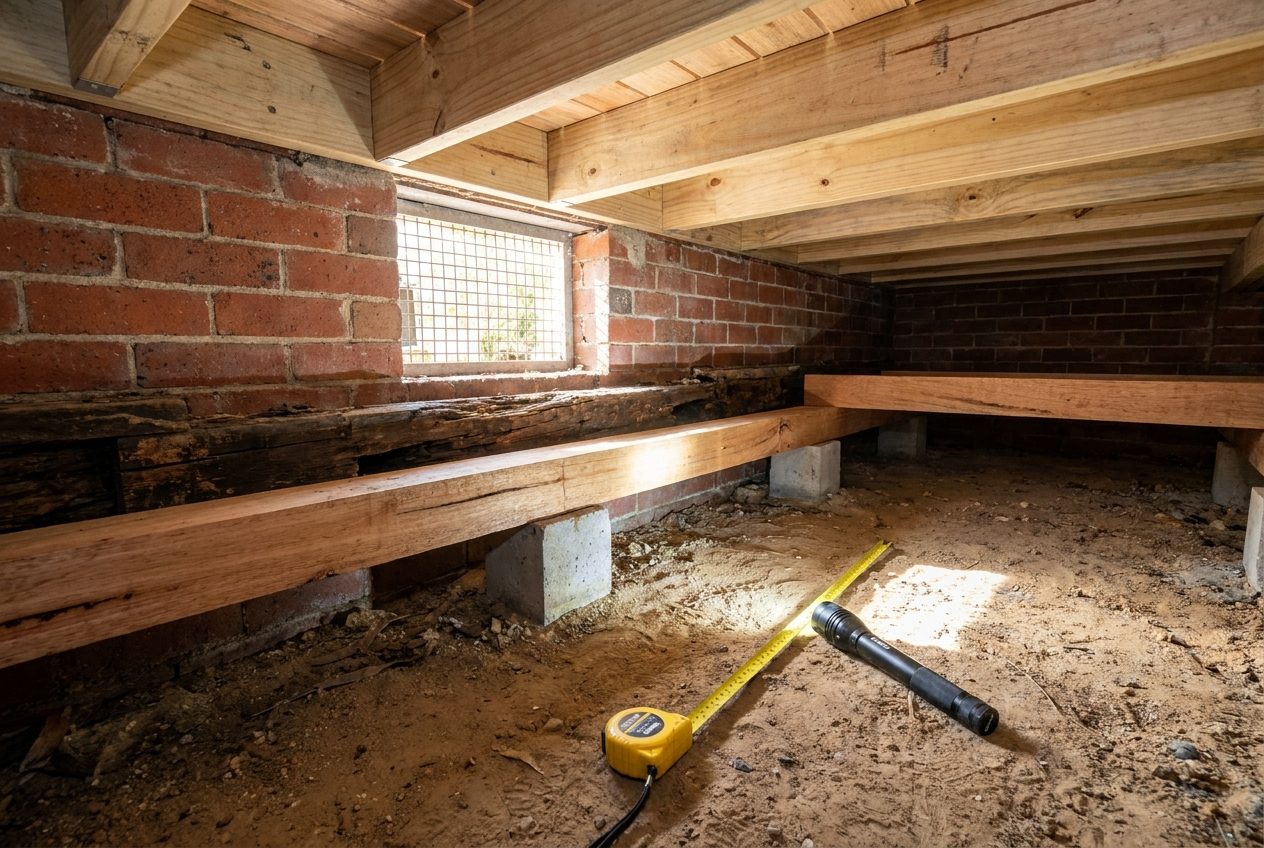
Subfloor repair cost in Sydney is one of the hardest things to guess before someone gets under the house. The floor you walk on hides the bearers, joists, piers and stumps that hold it up, and the price depends almost entirely on what is found down there: how much timber has failed, why it failed, and how easy it is to reach.
This guide explains what drives subfloor repair cost Sydney homeowners are quoted, shows published price ranges for the most common repairs, and covers what a proper quote should include so you can compare two of them fairly.
Subfloor Repair Cost Sydney: The Quick Answer
There is no single price, because subfloor repairs range from replacing one rotted joist end to rebuilding the whole floor frame. As a rough guide from published Australian cost guides in 2026:
- Bearer or joist replacement is commonly quoted per linear metre or per member, with published ranges of roughly $120 to $340 per linear metre.
- Replacing a single stump or pier is commonly quoted in the hundreds of dollars per stump, depending on material and access.
- Partial restumping or re-levelling of 5 to 10 stumps is commonly a few thousand dollars.
- Whole-house restumping or full floor frame replacement runs into the tens of thousands.
These are published ranges, not our prices, and Sydney jobs vary widely. The only reliable number is one based on someone actually inspecting your subfloor.
What the Subfloor Actually Is
Most older Sydney homes with timber floors sit on a suspended timber frame. From the ground up:
- Footings in the ground, with piers or stumps (brick, concrete, steel or timber) standing on them
- Bearers: the heavy beams that sit on the piers
- Joists: the smaller, closely spaced beams that sit across the bearers
- Flooring: the boards or sheets nailed to the joists
When any part of that chain fails, the floor above starts to move. Most subfloor repair cost comes from finding which part has failed and replacing it without disturbing everything above it.
Subfloor Repair Cost Sydney: Published Price Ranges
The table below collects ranges from independent Australian cost guides. They are useful for a sense of scale, but they are not Sydney-specific quotes and not our pricing.
| Repair | Published range | Source |
|---|---|---|
| Subfloor bearer or joist replacement | About $120 to $340 per linear metre | What’s The Damage, Oct 2026 |
| Bearer replacement, single span | About $900 to $2,400 | The Quote Yard (SA pricing), 2026 |
| Joist replacement, each | About $350 to $900 | The Quote Yard (SA pricing), 2026 |
| Stump replacement, per stump (supply and install) | About $160 to $640 depending on material | What’s The Damage, Oct 2026 |
| Partial restump or spot re-level (5 to 10 stumps) | About $2,200 to $5,600 | What’s The Damage, Oct 2026 |
| Subfloor inspection and written report | About $350 to $800 | The Quote Yard (SA pricing), 2026 |
| Subfloor ventilation upgrade | About $600 to $1,800 (passive vents) or $1,800 to $4,500 (mechanical) | The Quote Yard (SA pricing), 2026 |
| Whole house restump | Commonly $8,000 to $26,000+ | What’s The Damage, Oct 2026 |
Different guides quote stump prices differently. Canstar, citing hipages and LevelMaster, puts the average at around $500 to $700 per stump. The gap shows why a per-item price means little until someone has seen your access, soil and timber.
What Drives Subfloor Repair Cost Sydney Quotes
1. How much timber has actually failed
Rot and termite damage rarely stop neatly at one member. A joist that has rotted at the end often sits on a bearer that is damp in the same spot. A carpenter who replaces only the obvious piece leaves the cause behind. Expect the scope to be confirmed once the damaged area is opened up and probed.
2. Access and clearance under the house
This is the factor homeowners underestimate most. A house with a metre of clearance and a good access hatch is a very different job from one with 300mm of clearance under the kitchen. Low clearance can mean digging out, or lifting floorboards from above to reach the frame, which adds labour and making good.
3. Why it failed in the first place
Subfloor timber usually fails because of moisture: poor ventilation, a leaking pipe, a downpipe discharging next to the house, or garden beds built up against the walls. If the cause is not fixed, new timber will fail too. Fixing drainage, adding vents or repairing a leak is part of the real cost.
4. Termites
Active termites must be treated by a licensed pest controller before timber is replaced. Termite damage also tends to be more widespread than it first looks, because they hollow timber from the inside.
5. Floor levelling
Replacing a failed member stops the problem getting worse. Bringing a sagging floor back to level is extra work, usually packing or replacing stumps and adjusting bearers, and it can crack old plaster or bind doors that have adjusted to the slope.
6. Engineering and approvals
Like-for-like repairs normally do not need an engineer. Changing spans, removing piers, or work tied into an extension or structural change usually does. Engineering adds cost but protects you.
7. Making good above
If boards have to come up, they need to be relaid or replaced, and polished floors may need sanding and refinishing in that area. Ask whether this is included.
Why Sydney Subfloors Fail
Across Sydney we see the same patterns again and again:
- Older brick homes in St George and the Georges River with subfloor vents blocked by later renovations, paving or garden beds.
- Sloping blocks in the Sutherland Shire where water runs under the house after rain and the low side stays damp.
- Inner West terraces and cottages with very low clearance and timber that has been in the ground for a century.
- Bathrooms and laundries where slow leaks have soaked the joists below for years before anyone noticed.
Our guide to the signs of damaged bearers and joists explains what to look for from inside the house.
Repair, Sister or Replace?
| Approach | When it suits | Cost impact |
|---|---|---|
| Sistering | The member is mostly sound but undersized, split or damaged in one place | Usually the lowest cost, because the original stays in place |
| Partial replacement | Rot is limited to a bearing end | Moderate. The new joint has to be designed properly, not just patched |
| Full member replacement | The timber has rotted through or is hollowed by termites | Higher, especially with low clearance or long spans |
| Floor frame rebuild | Widespread failure across a room or the whole floor | Highest, often combined with new flooring |
Typical Subfloor Repair Jobs and What Shapes Their Cost
Every house is different, but most jobs we see fall into a handful of patterns. Knowing which one you have helps you understand where subfloor repair cost Sydney quotes come from.
One soft spot under a bathroom or laundry
A slow leak has rotted one or two joist ends and part of a bearer. The work is usually fixing the leak, cutting out the damaged timber, sistering or replacing the joists, and relaying a few boards. Cost depends mostly on access and how far the damp has spread.
A sloping room at the back of the house
A rear section built later than the main house, often on smaller piers, has settled. The fix usually involves packing or replacing piers or stumps and adjusting the bearers to bring the floor back towards level.
Widespread rot from blocked ventilation
Paving, garden beds or a later deck have blocked the subfloor vents for years. Several bearers and many joists show decay at their ends. This is a bigger job: replacing members across the area, then opening up or adding ventilation so it does not happen again.
Termite damage found during a renovation
Floorboards come up for a kitchen or bathroom renovation and termite damage is found in the joists. After treatment by a licensed pest controller, damaged timber is replaced while the floor is already open, which is usually the most cost-effective time to do it.
Whole-house restump
Older stumps across the house have rotted or sunk. This is usually priced per stump plus re-levelling, and published guides put full-house jobs in the tens of thousands.
Restumping vs Repairing Bearers and Joists
Homeowners often hear “restumping” and assume it covers everything. It does not. Restumping replaces the posts that hold the floor up. Bearer and joist repairs replace the timber frame that sits on those posts. Many jobs need both, some need only one.
- If the floor has dropped evenly in one area and the timber above is sound, the stumps or piers are the likely problem.
- If the floor is soft or springy but not sloping, the joists are the likely problem.
- If both are happening, the bearers, piers and joists all need checking.
A good inspection tells you which, so you are not paying to replace parts that are still sound.
Questions to Ask Before You Accept a Subfloor Quote
- What exactly has failed, and can you show me photos?
- What caused it, and how will that be fixed?
- Are you replacing or sistering, and why?
- Will the floor be re-levelled, and how close to level will it be?
- What happens if you find more damage once the floor is open?
- Is making good (boards, sanding, skirting) included?
- What is your licence number?
Our checklist for hiring a builder in Sydney covers the wider checks worth making.
What a Proper Subfloor Repair Quote Should Include
Two subfloor repair cost Sydney quotes can be far apart because they are pricing different jobs. Before comparing numbers, check that each quote states:
- Which members are being replaced or sistered, and roughly how many metres or pieces
- How the cause of the damage will be dealt with (ventilation, drainage, leaks)
- Whether termite treatment is needed and who arranges it
- Whether the floor will be re-levelled, or just stabilised
- How access will be gained, and whether boards need lifting
- What happens if more damage is found once work starts, and how that is priced
- Making good: relaying boards, sanding, skirting
- The contractor’s licence number. In NSW, residential building work worth more than $5,000 including GST (labour and materials) needs a licensed contractor, and a written contract. See NSW Fair Trading.
Our guide to understanding carpentry quotes in Sydney covers more on comparing quotes.
How to Keep Subfloor Repair Costs Down
- Act early. A springy patch is a cheap fix compared with a floor that has dropped.
- Fix the water first. Downpipes, leaks and blocked vents are cheap compared with replacing timber twice.
- Combine work. If you are renovating a kitchen or bathroom, fix the subfloor while the floor is open.
- Get a proper inspection. Paying for a clear scope avoids paying for surprises later.
- Keep the subfloor ventilated. Do not block vents with paving, decks or garden beds.
How Subfloor Repairs Are Done
- Inspection. Get under the house, probe timber, check moisture, look for termite activity and find the cause.
- Scope and quote. List what is being replaced, what is being sistered and how the cause will be fixed.
- Propping. Temporarily support the floor so failed members can be removed safely.
- Replacement. Install new bearers, joists or stumps, sized and fixed to AS 1684.
- Levelling and making good. Adjust packers, relay or replace boards and check doors and skirting.
Our subfloor repairs Sydney service covers each step, and for wider structural issues see structural carpentry Sydney.
Subfloor Repair Cost Sydney: Local Factors by Area
Where you live changes the subfloor repair cost Sydney homeowners face, because housing age, soil and slope vary across the city.
St George and the Georges River
Many post-war brick homes in Peakhurst, Mortdale, Oatley and Penshurst sit on brick piers with timber subframes. Rear additions and wet areas added later are the usual problem spots, often because vents were blocked by paving or garden beds. See carpenter St George.
Sutherland Shire
Sloping blocks mean tall piers on the low side and almost no clearance on the high side. Water running under the house after rain is a common cause of rot. See carpenter Sutherland Shire.
Inner West and inner city
Terraces and cottages with very old, very low subfloors. Access is often only possible by lifting boards, which adds cost.
Bankstown and south-west Sydney
Fibro and brick homes from the post-war era, sometimes with timber stumps rather than brick piers. Restumping is more common here.
Bayside and coastal suburbs
Sandy soils and higher humidity can affect ventilation and moisture levels under the floor.
Contracts, Deposits and Insurance in NSW
Subfloor repairs are residential building work, so NSW protections apply. According to the NSW Government’s building contracts guidance, work over $5,000 including GST needs a written contract, jobs from $5,000 to $20,000 use a small job contract, and jobs over $20,000 need a large job contract, home building compensation insurance and a five business day cooling-off period. The maximum deposit is 10 percent. Check the contractor’s licence first; our guide on how to check a builder’s licence in NSW explains how.
What a Good Subfloor Inspection Covers
- Clearance and access, and whether any areas can only be reached from above
- Condition of piers or stumps: cracking, leaning or sinking
- Bearers and joists probed for rot, especially at bearing points and near wet areas
- Moisture levels, standing water and drainage
- Ventilation: number and condition of vents, and whether any are blocked
- Termite activity or past damage
- Past alterations: cut or notched joists, removed piers
- Photos of every problem area
An inspection like this turns a vague “the floor feels soft” into a clear, priced scope.
How Long Does Subfloor Repair Take?
Replacing a few joists or packing a couple of piers can take a day or two. Replacing several bearers, re-levelling a room or restumping a section of the house can take a week or more. Whole-house restumping or floor frame replacement takes longer again. Most work happens under the house, so you can usually stay at home, with only the affected rooms disturbed if boards need lifting.
Subfloor Repair Cost Sydney: Key Takeaways
- Subfloor repair cost Sydney homeowners pay ranges from a few hundred dollars for one member to tens of thousands for a full rebuild.
- Access, the extent of damage and the cause of the failure drive the price more than the timber itself.
- Published ranges are a starting point; a quote based on an inspection is the only reliable number.
- Fixing moisture and ventilation is part of the job, not an optional extra.
Why Choose PROBUILDING AND CARPENTRY?
We are an owner-led, licensed NSW carpentry business (licence 458148C) based in Peakhurst, with more than eight years of hands-on experience in Sydney homes. We get under the house ourselves, show you what we find, and explain the options before we price anything. Call Hamzah on 0449 576 839 or visit our contact page.
Frequently Asked Questions
How much does subfloor repair cost in Sydney?
It depends on what has failed and how hard it is to reach. Published Australian guides put bearer and joist replacement at roughly $120 to $340 per linear metre, single stumps in the hundreds of dollars each, and whole-house restumping in the tens of thousands. A quote after inspection is the only reliable figure.
How much does it cost to replace a floor joist?
Published guides put a single joist replacement at roughly $350 to $900, depending on its length, where it sits and how easy it is to reach. Joists under kitchens or bathrooms with low clearance cost more.
Is subfloor repair covered by home insurance?
Usually not when the cause is gradual rot, wear or termites, which most policies exclude. Sudden events such as a burst pipe may be different. Check your policy wording or ask your insurer.
Can I live in the house during subfloor repairs?
Usually yes. Most subfloor work is done from underneath, and only the affected rooms are disturbed if boards need lifting.
Do I need council approval for subfloor repairs?
Like-for-like repairs to an existing floor frame usually do not. Structural changes, extensions or heritage-listed properties may. Check with your council if the work changes the structure.
How long do subfloor repairs take?
Small repairs can take a day or two. Larger jobs with re-levelling or many members can take a week or more. The inspection gives a realistic timeframe.
What causes subfloor damage in Sydney homes?
Mostly moisture from poor ventilation, leaks and drainage, plus termites. Blocked vents, garden beds against walls and slow plumbing leaks are common causes.
One Comment
Comments are closed.
about
PROBUILDING & CARPENTRY
Building Craftsmanship. Building Trust. Building Tomorrow

Let’s Build Something Exceptional

[…] guide to subfloor repair cost in Sydney explains what drives the price, and our subfloor repairs Sydney page explains how we fix […]