Bearers and joists are the parts of your house you never see, and that is exactly why problems with them go unnoticed for years. By the time a floor has visibly dropped, the timber underneath has usually been failing for a long time.
This guide covers the signs of damaged bearers and joists you can spot from inside and outside the house, what usually causes the damage in Sydney homes, how serious each sign is, and what to do next.
Signs of Damaged Bearers and Joists: The Short List
The most common signs of damaged bearers and joists are:
- A springy, bouncy or soft patch in the floor
- Floors that slope, dip or feel uneven underfoot
- Squeaks or creaks that are getting worse
- Gaps opening between floorboards and skirting boards
- Doors that stick, bind at the bottom or swing on their own
- Cracks in internal plaster above doors and windows
- Cupped or lifting floorboards
- A musty, damp smell, especially near floor vents
- Termite mud tubes or hollow-sounding timber under the house
- Visible rot, sagging or cracked timber in the subfloor
One sign on its own is not always a problem. Several together, or a sign that is getting worse, means it is time for an inspection.
What Bearers and Joists Do
In a suspended timber floor, bearers are the heavy beams that sit on brick piers or stumps. Joists are the smaller beams that run across the bearers at close spacing, and the floorboards are fixed to them. Together they carry everything in the house: walls, furniture, people and, in many homes, the roof loads that come down through the walls.
When a joist weakens, the floor above it flexes. When a bearer weakens, several joists lose support at once, and the problem shows across a whole section of the floor.
Signs of Damaged Bearers and Joists Inside the House
Springy or soft spots
A patch of floor that bounces when you walk across it, or feels softer than the rest of the room, is one of the clearest signs of damaged bearers and joists. It often means a joist has rotted, split or lost its bearing on the bearer below.
Sloping or uneven floors
If a marble rolls to one side of the room, furniture rocks, or you feel a dip when you walk, something underneath has dropped. That can be a failing bearer, a sinking pier or stump, or both.
Worsening squeaks
Old floors squeak. But squeaks that spread or get louder can mean joists are moving more than they should because their fixings or the timber itself are failing.
Gaps at skirting boards
A gap opening between the floor and the skirting is a sign the floor has moved down relative to the walls.
Doors that bind or swing
Doors that start catching on the floor, or no longer stay open, often reflect a floor that has shifted out of level.
Cracked plaster
Diagonal cracks above door and window frames can come from movement below. They have other causes too, which is why they should be looked at alongside the floor.
Cupped boards and musty smells
Boards whose edges lift above their centre, and a musty, earthy smell, are both signs of moisture under the floor. Moisture is what rots bearers and joists, so these are early warnings.
Signs of Damaged Bearers and Joists Under the House
If you can safely look under the house with a torch, these are the signs of damaged bearers and joists to look for:
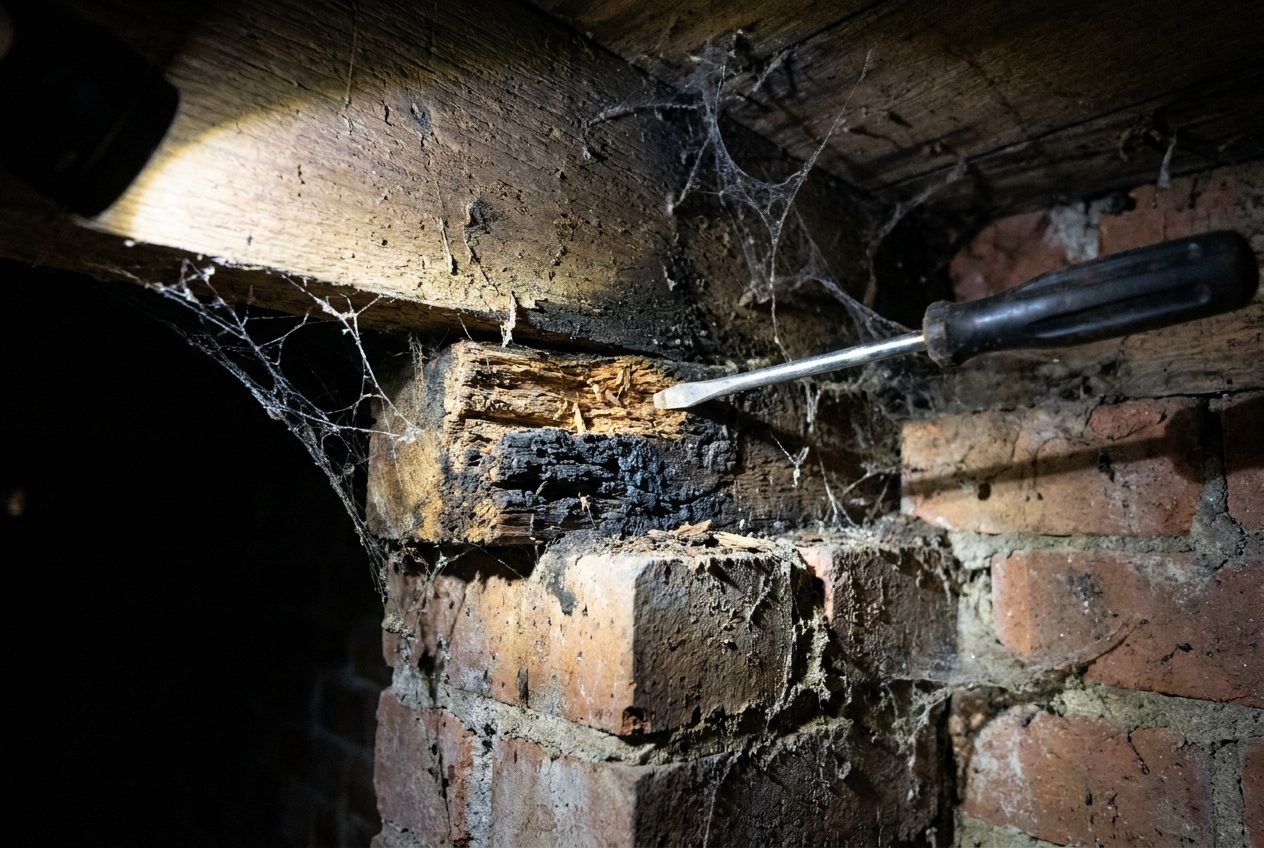
- Dark, damp or stained timber, especially where joists sit on bearers or bearers sit on piers
- Soft timber that a screwdriver pushes into easily
- Fungal growth, white or brown furry patches or cracked, cube-like timber
- Sagging members that dip in the middle of a span
- Cracked or split timber, or joists that have been notched or cut by past plumbing work
- Termite mud tubes on piers or walls, or timber that sounds hollow when tapped
- Leaning, cracked or sinking piers and stumps
- Standing water, damp soil or blocked vents
Only go under the house if it is safe to do so. Low clearance, wiring, sharp debris and possible asbestos in older homes are real hazards. If in doubt, leave it to an inspector or carpenter.
What Damages Bearers and Joists in Sydney Homes
Moisture and poor ventilation
This is the main cause. Subfloor vents get blocked by paving, garden beds, decks and later renovations. Without airflow, moisture builds up and timber rots, starting at the ends where it sits on piers.
Leaks
Slow leaks from bathrooms, laundries and kitchens can soak the joists below for years. Damaged bearers and joists under wet areas are among the most common finds.
Drainage
On sloping blocks, common in the Sutherland Shire and along the Georges River, water can run under the house after rain. Downpipes discharging next to walls do the same.
Termites
Subterranean termites are widespread in Sydney. They eat timber from the inside, so damage is often much worse than it looks. Termite damage to structural timber is serious and needs both treatment and repair. See this explainer on termite structural damage.
Past renovations
Joists notched too deeply for pipes, piers removed, and loads added above without strengthening the floor all weaken the frame.
Age
Many inner-city and inter-war homes still have original subfloor timber. Even good timber eventually reaches the end of its life in damp conditions.
How Serious Is Each Sign?
| Sign | Usually means | How soon to act |
|---|---|---|
| Occasional squeak | Loose fixings, normal wear | Monitor |
| Musty smell, cupped boards | Moisture under the floor | Soon: fix ventilation or the leak before timber rots |
| Springy or soft patch | A joist weakening or losing support | Book an inspection |
| Sloping floor, binding doors | A bearer, pier or stump has moved | Book an inspection |
| Termite mud tubes or hollow timber | Active or past termite activity | Urgent: call a licensed pest controller |
| Floor visibly dropping or cracking | Significant structural failure | Urgent: keep off the area and get it inspected |
Where Damaged Bearers and Joists Show Up in Different Sydney Homes
Federation and inter-war brick homes
Common across St George, Bexley and the Inner West. Original hardwood subfloors are often still in good shape in the middle of the house, but rear additions, bathrooms and areas near blocked vents are where damage shows first.
Post-war brick and fibro homes
Typical in Peakhurst, Mortdale, Padstow and Revesby. Timber subfloors on brick piers, often with low clearance at the back. Laundries and bathrooms added later are frequent problem spots.
Terraces and workers’ cottages
In Rozelle, Balmain and the inner city, subfloors can be very low and very old, sometimes with timber sitting close to the ground. Damage may only be reachable by lifting boards.
Homes on sloping blocks
In the Sutherland Shire and along the river, the low side of the house often has tall piers and stays damp after rain, while the high side has almost no clearance. Both ends need checking.
A Simple Self-Check You Can Do Today
- Walk every room slowly and note any bouncy, soft or sloping spots.
- Roll a marble or use a phone level app on the floor in suspect rooms.
- Check doors open and close without catching.
- Look along skirting boards for new gaps.
- Walk around the outside and check every subfloor vent is clear.
- Check downpipes discharge into drains or away from the house.
- If it is safe, look under the house with a torch for damp, staining or mud tubes.
- Write down what you find and take photos. It makes an inspection faster and more useful.
If several of these checks turn up signs of damaged bearers and joists, it is worth booking a professional look.
What to Do If You Find Signs of Damaged Bearers and Joists
- Do not ignore it. Subfloor problems almost always get worse and more expensive.
- Find the moisture source. Check for leaks, blocked vents and poor drainage.
- Rule out termites. If you see mud tubes or hollow timber, call a licensed pest controller before any timber is disturbed.
- Get an inspection. A carpenter or building inspector can probe the timber and tell you what has failed.
- Get a clear scope. A proper quote lists which members are being replaced and how the cause will be fixed.
Our guide to subfloor repair cost in Sydney explains what drives the price, and our subfloor repairs Sydney page explains how we fix it.
How Damaged Bearers and Joists Are Repaired
- Sistering: bolting a new member alongside a damaged one, when most of the original is sound.
- Partial replacement: cutting out a rotted end and splicing in new timber with a properly designed joint.
- Full replacement: removing and replacing the member, with the floor propped while it is out.
- Pier and stump work: replacing or packing sunken stumps and piers so bearers are supported again.
- Fixing the cause: ventilation, drainage and leak repairs so the new timber lasts.
Where damage affects walls or roof loads, it becomes broader structural work. See structural carpentry Sydney.
How to Prevent Bearer and Joist Damage
- Keep subfloor vents clear. Do not build garden beds, paving or decks over them.
- Make sure downpipes discharge away from the house.
- Fix plumbing leaks quickly, especially in bathrooms and laundries.
- Have regular termite inspections, as recommended for Sydney homes.
- Do not let anyone cut or notch joists without checking it is safe.
What It Costs to Fix Damaged Bearers and Joists
Repair costs depend on how much timber has failed, how easy it is to reach and what caused the damage. Published Australian cost guides put subfloor bearer or joist replacement at roughly $120 to $340 per linear metre, with single joist replacements and single-span bearer replacements in the hundreds to low thousands of dollars each. Our subfloor repair cost Sydney guide sets out the published ranges and what drives them. These are published ranges, not our prices.
| Damage found | Typical repair | Relative cost |
|---|---|---|
| One or two joist ends rotted | Sister or splice joists, fix the moisture source | Lower |
| One bearer rotted over a pier | Replace or sister the bearer, check the pier | Moderate |
| Several joists and bearers under a wet area | Replace members, fix leak and ventilation | Moderate to higher |
| Sinking piers or stumps | Pack or replace piers or stumps and re-level | Moderate to higher |
| Widespread rot or termite damage | Replace large parts of the floor frame | Highest |
Signs of Damaged Bearers and Joists Across Sydney
St George and the Georges River
In Peakhurst, Mortdale, Oatley and Penshurst, the most common finds are rotted joists under bathrooms and laundries added in later decades, and bearer ends decayed where vents were blocked. See carpenter St George.
Sutherland Shire
Sloping blocks often show signs of damaged bearers and joists on the low side, where water collects after rain. See carpenter Sutherland Shire.
Inner West terraces and cottages
Very old subframes with low clearance. The first sign is often a soft spot near the back of the house or a sloping floor in the kitchen.
Bankstown and Liverpool
Post-war homes on timber stumps, where sinking or rotted stumps cause uneven floors.
What to Expect From a Subfloor Inspection
If you see signs of damaged bearers and joists, a professional inspection is the next step. A good inspection includes:
- Getting under the house where it is safe to do so
- Probing bearers, joists and stumps for soft timber
- Checking moisture, drainage and ventilation
- Looking for termite activity or past damage
- Checking piers and stumps for movement
- Photos and a clear explanation of what was found
- A written scope and quote for the repairs
Our subfloor repairs Sydney service starts with exactly this kind of inspection.
Is Bearer and Joist Damage Covered by Insurance?
Home insurance policies commonly exclude gradual deterioration, wear and tear, rot and termite damage. Damage caused by a sudden event, such as a burst pipe, may be treated differently. Check your policy wording and speak to your insurer before assuming either way.
Getting the Repairs Done Properly
For residential repair work over $5,000 including GST, NSW requires a licensed contractor and a written contract, and the maximum deposit is 10 percent. Check the contractor’s licence first using the NSW Government licence check; our guide on how to check a builder’s licence in NSW shows how. See the NSW Government contracts guidance for the full rules.
Key Takeaways
- Springy, sloping or soft floors are the clearest signs of damaged bearers and joists.
- Musty smells and cupped boards are early signs of damaged bearers and joists caused by moisture.
- Moisture is the main cause, followed by termites and past renovations.
- Early repair is far cheaper than waiting for a floor to drop.
- Always fix the cause, not just the timber.
Why Choose PROBUILDING AND CARPENTRY?
We are a licensed NSW carpentry business (licence 458148C), owner-led by Hamzah Elfoul, based in Peakhurst with more than eight years of experience in Sydney homes. We get under the house ourselves, show you what we find and explain your options before we quote. Call 0449 576 839 or visit our contact page.
Frequently Asked Questions
What are the first signs of damaged floor joists?
The early signs of damaged bearers and joists are usually a springy or soft patch in the floor, squeaks that get worse, or a musty smell. These often appear well before the floor visibly sags.
Can a sagging floor be fixed without replacing the whole floor?
Usually yes. Most repairs replace or sister only the damaged bearers and joists and re-level the affected area, without lifting the whole floor.
Is a bouncy floor dangerous?
A slightly bouncy floor is not usually an immediate danger, but it is a sign something underneath is weakening. A floor that is soft, cracking or dropping should be kept clear and inspected promptly.
Do termites cause bearer and joist damage?
Yes. Subterranean termites are common in Sydney and eat timber from the inside. Treatment by a licensed pest controller must come before structural repairs.
Who should I call for damaged bearers and joists?
A licensed carpenter or builder for repairs, a licensed pest controller if termites are suspected, and a plumber if a leak is the cause. A building inspector can also assess the subfloor.
How often should I check under my house?
A quick look at least once a year, and after heavy rain, is sensible. Regular termite inspections are also recommended for Sydney homes.
2 Comments
Comments are closed.
about
PROBUILDING & CARPENTRY
Building Craftsmanship. Building Trust. Building Tomorrow

Let’s Build Something Exceptional

[…] guide to the signs of damaged bearers and joists explains what to look for from inside the […]
[…] where they sit on piers or against the house wall, the subframe needs replacing too. Our guide to signs of damaged bearers and joists explains what to look […]